
Travel to historical Odisha
Come and experience Odisha and its temples, history and musicals. Renowned for its dolphin watching, ecotours and archaeology, this city welcomes all visitors. With a holiday rental, you get a home away from home – many rentals offer full kitchens and outdoor grills for some home cooking.
Activities and attractions in and around Odisha
Are you hoping to discover top things to see and do while you're in town? Venture out of your holiday home and check out everything that makes Odisha a fun place to get away to. Here are some of the most popular attractions to see, all within 30 miles (48.2 km) of the city centre:
- Ocean World Water Park (7.1 mi / 11.5 km)
- Nandankanan Zoological Park (9.6 mi / 15.5 km)
- Qadam-I-Rasool (0.6 mi / 1 km)
- Ashokan Rock Edict (2.7 mi / 4.3 km)
Exploring the natural landscape of Odisha
Whether you're looking for adventure or just want to take in the scenery, you'll be sure to find the perfect setting for your holiday in Odisha. Here are a few of the area's most stunning natural features, all within 30 miles (48.2 km) of the city centre:
- Bindu Sagar (1.3 mi / 2.1 km)
- Udayagiri and Khandagiri Caves (3.5 mi / 5.6 km)
- Buddha Jayanti Park (4.9 mi / 7.8 km)
- Barabati Fort (15.6 mi / 25.2 km)
- Ekamra Kanan (3.9 mi / 6.3 km)
- Daya River (9.6 mi / 15.4 km)
How to get to and around Odisha
The nearest airport is in Bhubaneshwar (BBI-Biju Patnaik), located 1.6 mi (2.6 km) from the city centre.
If you prefer to travel by train, Bhubaneswar Station, Mancheswar Station and Retang Station are the main stations in the city.


![Chilika lake is a brackish water lagoon, spread over the Puri, Khurda and Ganjam districts of Odisha state on the east coast of India, at the mouth of the Daya River, flowing into the Bay of Bengal, covering an area of over 1,100 km2. It is the largest coastal lagoon in India and the second largest lagoon in the world[3][4][dubious – discuss] after The New Caledonian barrier reef in New Caledonia.
It is the largest wintering ground for migratory birds on the Indian sub-continent. The lake is home to a number of threatened species of plants and animals.
The lake is an ecosystem with large fishery resources. It sustains more than 150,000 fisher–folk living in 132 villages on the shore and islands.
The lagoon hosts over 160 species of birds in the peak migratory season. Birds from as far as the Caspian Sea, Lake Baikal, Aral Sea and other remote parts of Russia, Kirghiz steppes of Mongolia, Central and southeast Asia, Ladakh and Himalayas come here. These birds travel great distances; migratory birds probably follow much longer routes than the straight lines, possibly up to 12,000 km, to reach Chilika Lake.
In 1981, Chilika Lake was designated the first Indian wetland of international importance under the Ramsar Convention.
According to a survey, 45 percent of the birds are terrestrial in nature, 32 percent are waterfowl, and 23 percent are waders. The lagoon is also home to 14 types of raptors. Around 152 rare and endangered Irrawaddy dolphins have also been reported. Plus, the lagoon supports about 37 species of reptiles and amphibians.
The highly productive chilika lagoon eco-system with its rich fishery resources sustains the livelihood for many fisher men who live in and near the Lagoon. The water spread area of the Lagoon ranges between 1165 and 906 km2 during the monsoon and summer respectively. A 32 km long, narrow, outer channel connects the lagoon to the Bay of Bengal, near the village Motto. More recently a new mouth has been opened by CDA which has brought a new lease of life to the lagoon.
Microalgae, marine seaweeds, sea grasses, fishes and crabs also flourish in the brackish water of the Chilika Lagoon. Especially the recovery of sea grass beds in recent years is a welcoming trend which may eventually result in re-colorizations of endangered dugongs.](https://images.trvl-media.com/place/553248621562261891/1e8fd9af-7b1f-490e-95b1-2f9fb2318e30.jpg?impolicy=fcrop&w=600&h=400&p=1&q=medium)

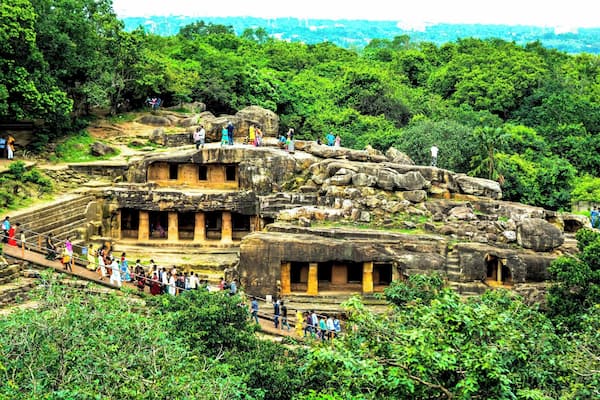
![Udayagiri and Khandagiri Caves are partly natural and partly artificial caves of archaeological, historical and religious importance near the city of Bhubaneswar in Odisha, India. The caves are situated on two adjacent hills, Udayagiri and Khandagiri, mentioned as Kumari Parvat in the Hathigumpha inscription. They have a number of finely and ornately carved caves built during 2nd century BCE.[1] It is believed that most of these caves were carved out as residential blocks for Jain monks during the reign of King Kharavela.[2] Udayagiri means "Sunrise Hill" and has 18 caves while Khandagiri has 15 caves.[3]
The caves of Udayagiri and Khandagiri, called lena or leṇa in the inscriptions, were dug out mostly during the reign of Kharavela for the abode of Jaina ascetics. The most important of this group is Ranigumpha in Udayagiri which is a double storeyed monastery. Other important caves include Hathi gumpha, Ananta gumpha, Ganesha gumpha, Jaya Vijaya gumpha, Mancapuri gumpha, Bagh gumpha and Sarpa gumpha.](https://images.trvl-media.com/place/501/2282ce89-b81c-4283-b512-b77afc88809e.jpg?impolicy=fcrop&w=600&h=400&p=1&q=medium)


