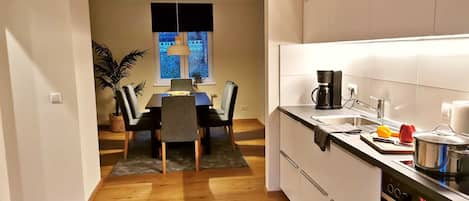
A very stylishly furnished, spacious 70 m² duplex apartment on the 1st floor and top floor of a beautiful natural-stone building, directly off the Mediterranean-style patio.
The apartment was newly built in 2015.
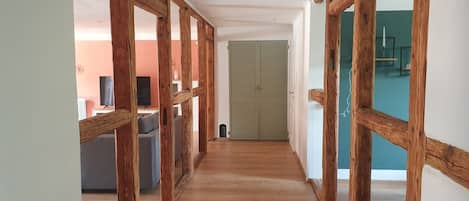
There are two 90 x 200 cm beds in the bedroom that can be pushed together to form a double bed. However, they can also be set up separately. In the hallway leading to the bedroom, there are two additional 90 x 200 cm beds for a third or even fourth person.
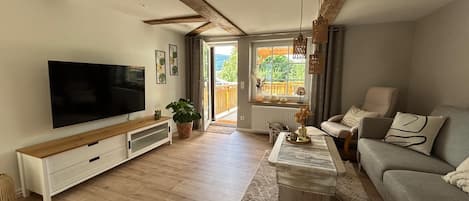
The living room features a pull-out sofa with a single, continuous mattress measuring 150 x 200 cm.
Höxter/Lüchtringen is ideally located for your holiday excursions in the surrounding area or a side trip to the region’s attractions. At the same time, you’ll find the peace and quiet you need to recover from the day’s activities and experiences.
The advantages of our location in detail
- City or nature: Many interesting destinations for day trips and hikes
- A diverse range of cultural and recreational activities for all ages
- A wide selection of dining options
- Convenient transport connections by car, bus, and train
The Weserbergland is a low mountain range reaching heights of up to 527.8 m above sea level[1], stretching along both banks of the Weser between Hann. Münden and Porta Westfalica within the Lower Saxony Uplands in Lower Saxony, Hesse, and North Rhine-Westphalia in Germany.
The largest contiguous forested area in the Weserbergland is located on the Solling in the Solling-Vogler Nature Park. This forested area, interrupted only by the isolated Uslar Basin and the narrow Weser Valley, extends southward towards the Reinhardswald (on the left bank of the Weser) and the Bramwald (on the right). Even beyond the Fulda and Werra rivers—and thus outside the Weserbergland—the dense forest continues further south without any significant interruption, merging into the Kaufunger Forest.
In addition to the main mountain ranges listed above, other low mountain ranges and ridges are occasionally included in the Weserbergland.
Culture
A distinctive architectural style developed in the Weserbergland. Between 1520 and 1640, the so-called Weser Renaissance gave rise to a significant concentration of Renaissance architecture here.
Well-known beyond the region are the Pied Piper of Hamelin, the “Baron of Lies” Karl Friedrich Hieronymus von Münchhausen—who hailed from Bodenwerder—and the German artisan surgeon, wound specialist, and star-piercer Dr. Eisenbarth, who died in Hann. Münden.
The region is also home to several of the Brothers Grimm’s fairy tales, such as Snow White, which is said to take place in Alfeld, Rapunzel, who is said to have let her long hair down from a tower at Trendelburg Castle to her prince, or Sleeping Beauty, whose castle is said to be the Sababurg ruins near Hofgeismar.
Painters
The picturesque landscape of the Weserbergland has inspired numerous painters and visual artists: Robert Batty, Christian Andreas Besemann, Carl Büttger, Carl Ferdinand Fabritius, Robert Geißler, Wolfgang Heinrich, Karl Arthur Held, Alfred Hesse, Rudolf Jahns, Herbert Mager, Jacob Pins, Anton Wilhelm Strack, Pascha Johann Friedrich Weitsch, August Wenderoth.
Tourism
In addition to the historic towns mentioned above and the Weserbergland Schaumburg-Hameln Nature Park and the Solling-Vogler Nature Park, the approximately 500-kilometer-long Weser Cycle Route, which runs along the Weser River, is of significant importance to tourism. The rare Süntel beech trees are a botanical highlight. The Rühler Schweiz region offers a charming landscape. The west facade of the abbey church in Corvey (Höxter) is an UNESCO World Heritage Site.
Motorcycle tourism is growing in importance. Along with the Harz Mountains, the Weserbergland is a popular motorcycle destination in northern Germany. In particular, the Köterberg—the highest point from this location to the North Sea—is a popular motorcycle meeting spot offering panoramic views up to 80 kilometres.
Also worth mentioning are the Schillat Cave, Tonenburg Castle in Höxter-Albaxen, the Neuhaus Wildlife Park, the Weserstein in Hann. Münden, as well as several museums such as the Agricultural Technology Museum in Börry, the Blankschmiede in Dassel, the German Huguenot Museum in Bad Karlshafen, and the Motorcycle



![Immediate Surroundings [summer] (<1 km)](https://media.vrbo.com/lodging/66000000/65430000/65421000/65420954/8b141152.jpg?impolicy=fcrop&w=469&h=201&p=1&q=medium)




![Holiday Home Exterior [summer]](https://media.vrbo.com/lodging/17000000/16570000/16561000/16560996/5fa9404a.jpg?impolicy=fcrop&w=469&h=201&p=1&q=medium)


![Surroundings [summer] (1-5 km)](https://media.vrbo.com/lodging/96000000/95410000/95407200/95407101/5e4d3efc.jpg?impolicy=fcrop&w=469&h=201&p=1&q=medium)

